
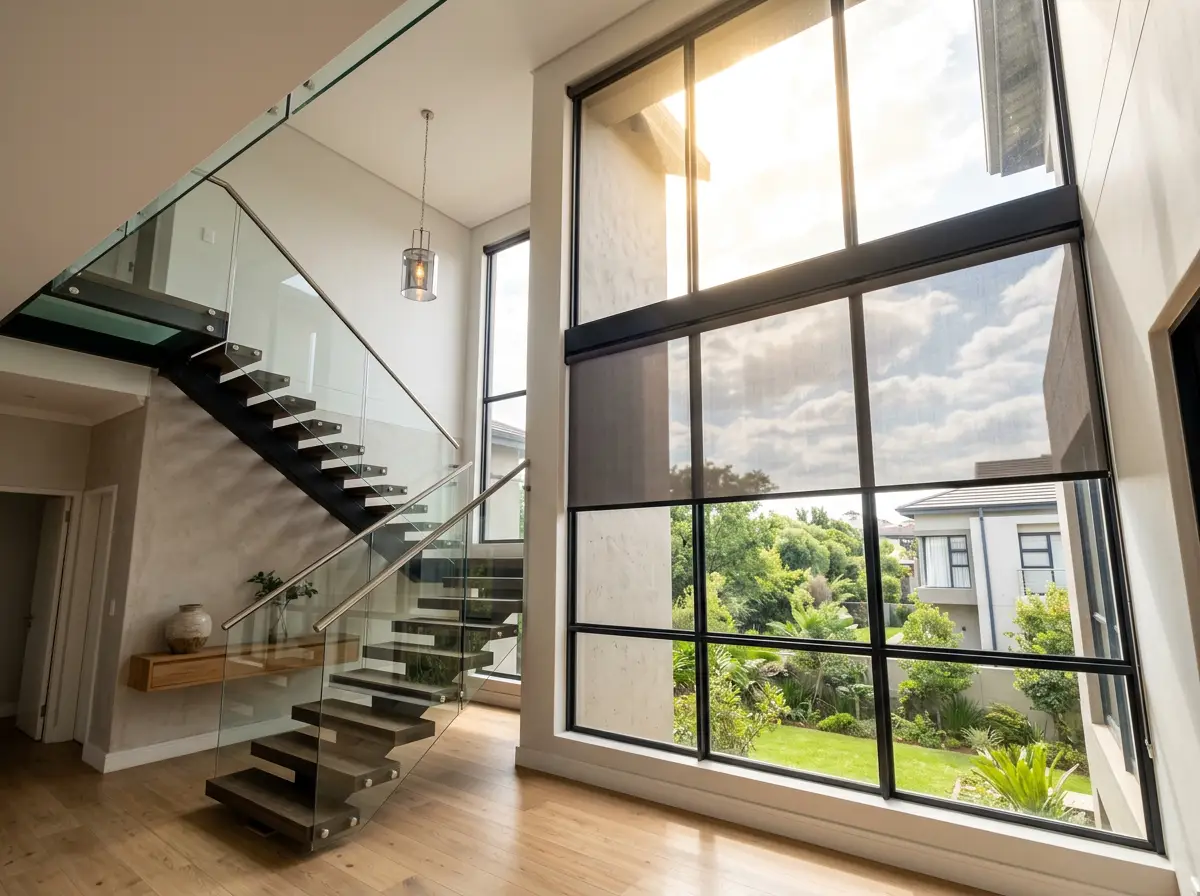
The premium upsell on most homes, and on a Southdowns double-volume window or stairwell, the only practical option.
Why this is closer to standard than upgrade here
Southdowns' open-plan architectural brief brings in a lot of glass a hand can't comfortably reach — double-volume living areas, stairwell windows two or three storeys up, wide sliding walls onto the garden. A chain or wand works fine on a normal window; it's simply the wrong tool for most of what Southdowns actually builds.
Motors sit inside the blind roll and run off rechargeable battery packs — no wiring, retrofit-friendly, a charge every few months — or a wired 220V system for new builds and renovations, best for the bigger and heavier runs. Control comes from a handset remote, an app, a schedule (bedroom blinds open with sunrise, west-facing ones drop before the afternoon heat), or a sensor that does the thinking for you.
- No dangling chains — the most child-safe operation there is
- Battery motors: no wiring, a charge every few months
- Wired 220V: for new builds and renovations, best for big or heavy runs
- Sun sensors drop shading automatically on the hot west elevation
- Wind sensors retract exterior products before a highveld storm
What motorisation costs, product by product
Motorisation is priced by what the motor drives, so the honest answer is a range: R2,500 to R7,500 per square metre installed across the range, as a guide. A motorised blockout or sunscreen roller sits at R2,500 to R3,800. A motorised concealed or recessed system runs R3,200 to R5,000. A motorised folding-arm awning, priced on projection rather than glass area, runs R5,500 to R7,500.
Those bands include the motor, the handset or wall control and the commissioning on the day. Electrical work is not included: a wired 220V motor needs a point at the head of the opening, and that is the electrician's line. On a double-volume stairwell window, where cabling has to arrive without chasing a wall, a rechargeable battery motor is often simpler and asks for a charging routine instead. Small blinds attract a minimum, and nothing is fixed until the free measure and the written quote.
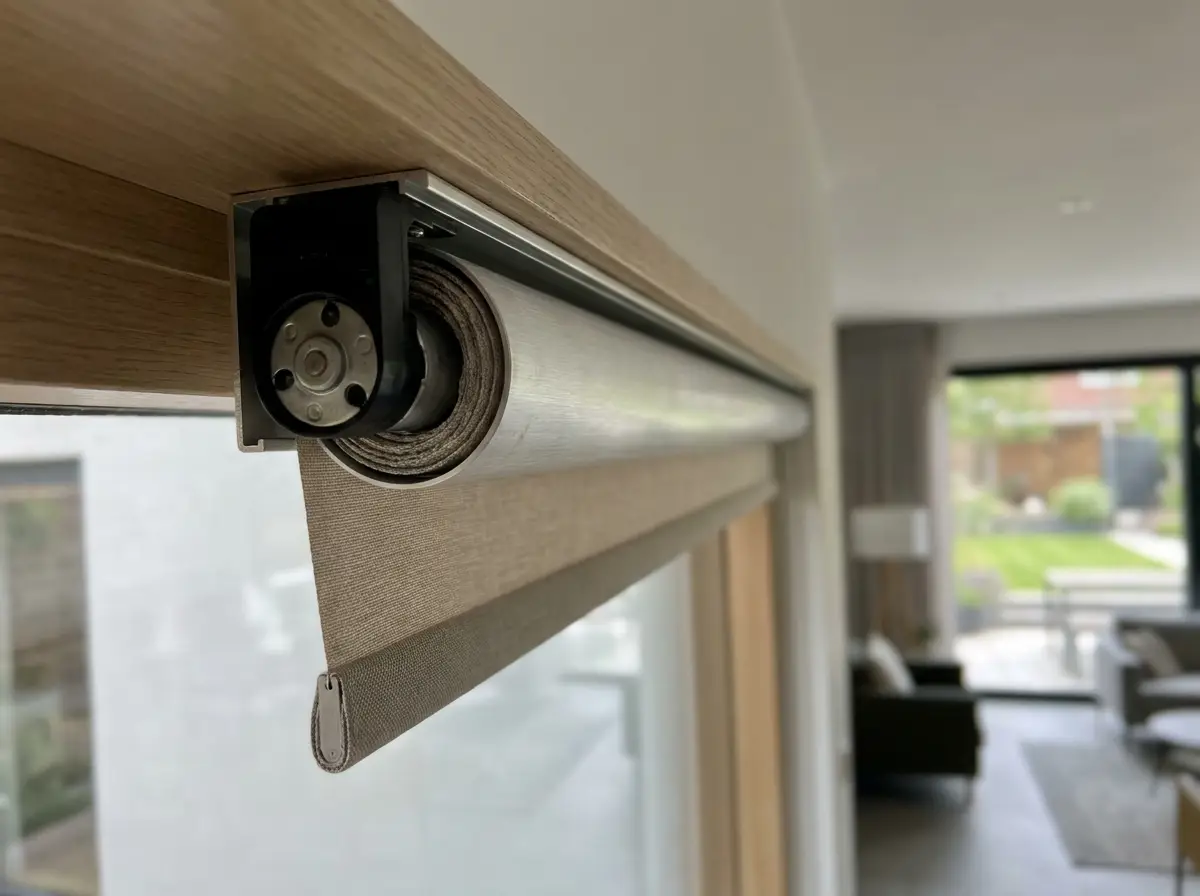
Motorised from the start, not added as an afterthought
Ask any Southdowns owner which window bothers them most and it's rarely the small one over the kitchen sink — it's the one three metres up a stairwell or across a double-volume void, original to the build and never quite finished off. We measure it like any other opening and quote it with a motor from the start, because a wand solution there just means someone climbing a ladder every afternoon.
Pair it with a concealed or recessed system if the opening was planned into the ceiling at design stage, so the fabric drops from a hidden slot and the motor never shows either.
Motorised blinds across the wider Irene belt
Double-volume glazing isn't unique to Southdowns — Cornwall Hill's larger stands and Raslouw's newer cluster estates carry the same reach problem, and we spec motorisation there on the same logic.
Not sure which windows need a motor?
Bring us the tricky ones — stairwells, double-volume walls, anything you'd rather not reach with a pole. We'll tell you honestly where it's worth it.