Nearly every homeowner who calls us about heat points at the north side of the house, because that is where the sun spends the day. On the highveld that instinct is usually wrong, and acting on it makes a house darker in July without making it cooler in January. Up here the sun in midsummer stands almost directly overhead, so a decent eave does most of the north-facing work for free — while the real damage arrives sideways, late, off the west, in the last three hours before a storm builds. This guide is about getting that the right way round in a Southdowns house.
Fourteen hundred metres up, and a long way from any sea
Southdowns sits in Centurion, in the Irene belt, at roughly 1,453 metres above sea level1 — on the highveld, the great interior plateau that carries most of Gauteng and reaches into the Free State and Mpumalanga.2 There is no coastline within several hundred kilometres in any direction.
That matters more than it sounds. Almost all the shading advice written in this country is written from the coast, and it is preoccupied with things we simply do not have here: salt corrosion, onshore wind, sea glare, damp that never leaves the air. Delete all of it. The highveld hands you a different set of four:
A summer sun that is almost vertical at midday, and a winter one that is low, northerly and genuinely useful.
More ultraviolet than a coastal house gets, simply because there is less atmosphere above you.
A storm season that arrives in the afternoon and can carry hail.
Dry, clear winter nights that dump a house's heat straight out through its glass.
Everything below follows from those four. Nothing below is about the sea.
Two
Why a north window behaves itself
Published sun-path data for this part of the country gives a midsummer noon sun of about 87 degrees above the horizon — within a few degrees of straight up — and a midwinter noon sun of about 40 degrees.3 Hold those two numbers next to each other and the whole north elevation explains itself.
In December, a beam coming down at 87 degrees can barely get under an eave, a first-floor slab edge or a patio roof. It lands on the sill and the ground outside, not on your couch. In June, at 40 degrees, the same window lets the sun reach several metres into the room — and in a highveld winter that is free heating you have already paid for in the architecture.
A north window in Centurion is not a heat problem eleven months of the year. It is an asset with a short bad temper in the middle of the day.
Which produces the single most common mistake we are called in to fix here: heavy blockout fabric fitted wall to wall on the north side of a house, to solve a glare problem that lasts a couple of hours a day for a few weeks. The room ends up dim and cold from May onwards, and the January afternoon still gets in through the west.
What we'd fit on a north elevation
A light sunscreen mesh, not blockout, in living rooms and studies. It knocks the glare off a screen or a table without turning the room grey, and it lifts clear when you want the winter sun.
Aluminium or timber venetians where you want to steer light rather than block it — tilt the slats up and the beam goes onto the ceiling, which lights the room without cooking anyone sitting under the window.
Worth checking before you buy anything: measure how far your eave already projects and how far the summer sun actually reaches into that room at midday. If the floor stays clear in December, the north side does not need a product — it needs to be left alone.
Three
The elevation that actually cooks
Now the other bearing. In midsummer the sun here sets on a bearing of roughly 243 degrees — west-south-west, not due west — while in midwinter it sets around 295.3 So the wall taking the punishment in January is the one that faces west and swings round toward the south-west corner, and it takes the beam from about four in the afternoon until the sun goes down.
Late sun is low sun, and low sun defeats everything built above a window. An eave that shades a north window perfectly at midday does nothing whatever against a beam arriving at fifteen degrees off the horizontal. It comes in under the overhang, straight down the length of the room, onto the exact wall your television is on.
An interior blind on that elevation is fighting after the fact. Glass lets solar energy through easily; the moment that energy strikes a surface inside the room it becomes heat, and heat does not leave through glass at anything like the same rate. So a blind behind the pane saves your floor and your eyes, and the room still climbs. Put something in front of the pane and there is nothing to trap in the first place.
The premium answer, and it belongs outside the glass
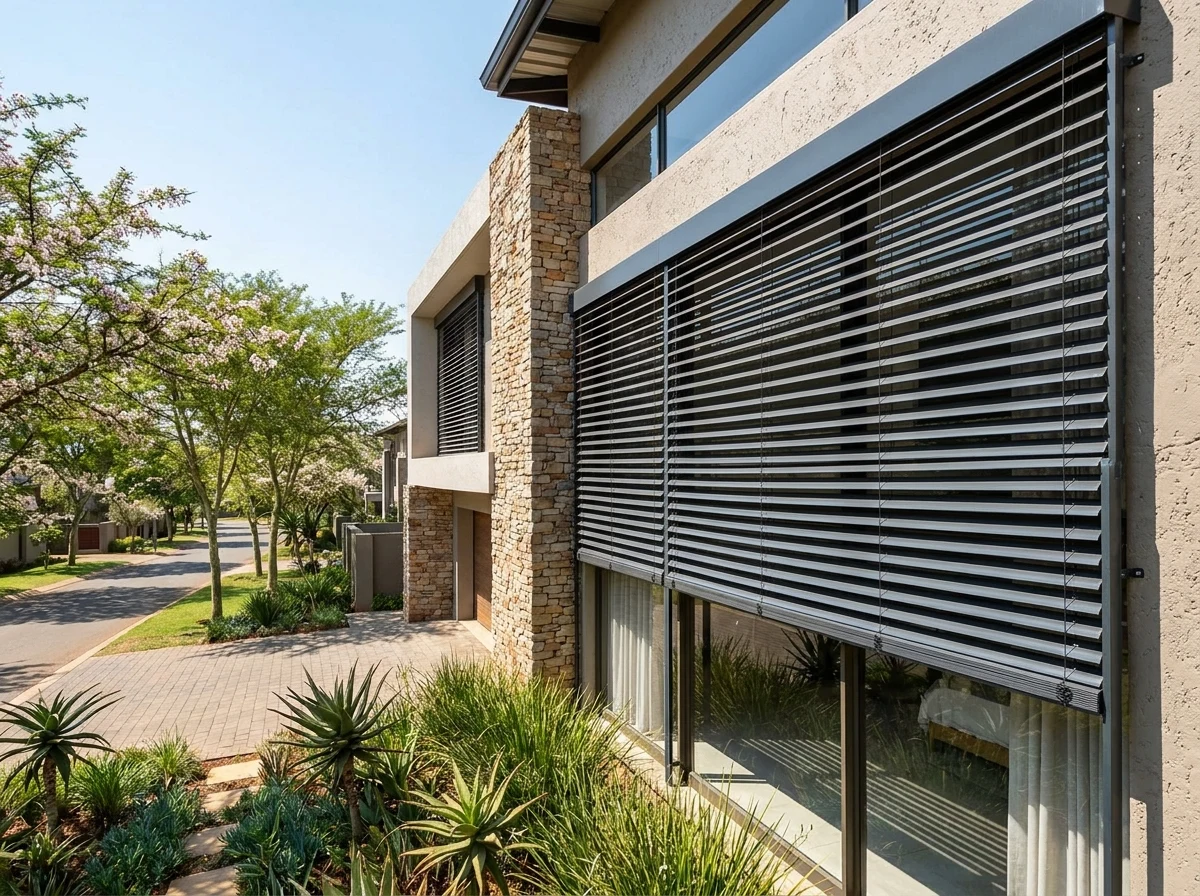
External venetian blinds are the first thing we would specify on a hard west elevation. Aluminium slats mounted proud of the window that both lift and tilt, so a low beam is deflected while you keep a view out underneath it — and in winter they raise fully out of the way so the house gets its low sun back.
Roller shutters where a room wants everything at once: full shade, an insulating pocket of air against the pane, and a real reduction in outside noise. Said plainly, these are shading shutters for sun, heat, glare and privacy — they are not a security-rated product, and we would rather tell you that now than let you assume.
Zip screens where the space to control is a veranda or patio rather than a window. The mesh runs in side channels under tension, so it holds its shape in a gust instead of flapping about.
What it costs you: every one of those fixes to the outside of the building. That means a proper structural fixing, a higher price than any interior blind, and an estate approval conversation before you order. Where an external product genuinely will not work on your elevation, a sunscreen roller inside the glass remains a sensible move — just do not expect it to solve the temperature.
Slats down on the sun-struck side of an estate house — the glass behind them never gets the chance to warm up.Four
Altitude has a sting, and it isn't heat
Here is the part that catches people out, because it does not announce itself. Ultraviolet radiation rises with altitude — the World Health Organization puts the increase at roughly 10 to 12 per cent for every thousand metres, because there is less air, less aerosol and less ozone between you and the sun.4 On our own arithmetic from that figure, a house at Southdowns' altitude is taking in the order of fifteen per cent more UV than the same house would at the coast.
UV is not what you feel on your arm. That is infrared. UV is what fades a rug, bleaches a timber floor along one strip, chalks a leather couch, and ages the fabric of the blind itself. It is a slow bill, and it lands on the same west and north-west rooms discussed above.
How we handle it
Ask for the openness factor on any sunscreen fabric you are quoted. A lower figure means a tighter weave, less glare and more UV stopped; a higher one keeps more of the view. It is a real, printed number and it is the honest way to compare two meshes that look identical in a swatch book.
Put the shading outside where the contents matter. A room with a piano, artwork, a natural-fibre rug or a pale timber floor is a room where the argument for external shading stops being about comfort and starts being about replacement cost.
Being straight about it: no blind stops all UV, and any fabric hanging in a highveld window is itself living in hard light. Choose UV-stable fabric, and expect an exterior product's fabric to be a wearing part over a long enough horizon — the hardware should outlast it comfortably.
Five
Storm season, and the one thing no fabric survives
This is summer-rainfall country: rain arrives between roughly October and March, usually as afternoon and evening thunderstorms rather than steady weather.2 October and November carry a high frequency of severe storms over the highveld in particular, and hail falls more often over the highveld of Gauteng, the eastern Free State and Mpumalanga than anywhere else in the country.5
Everyone who has lived through a Centurion December knows the shape of it: a clear hot morning, cloud stacking up from mid-afternoon, a black wall arriving over the ridge, twenty violent minutes, then a cool evening. Outdoor shading has to be designed around that pattern, not around the pleasant part of the day.
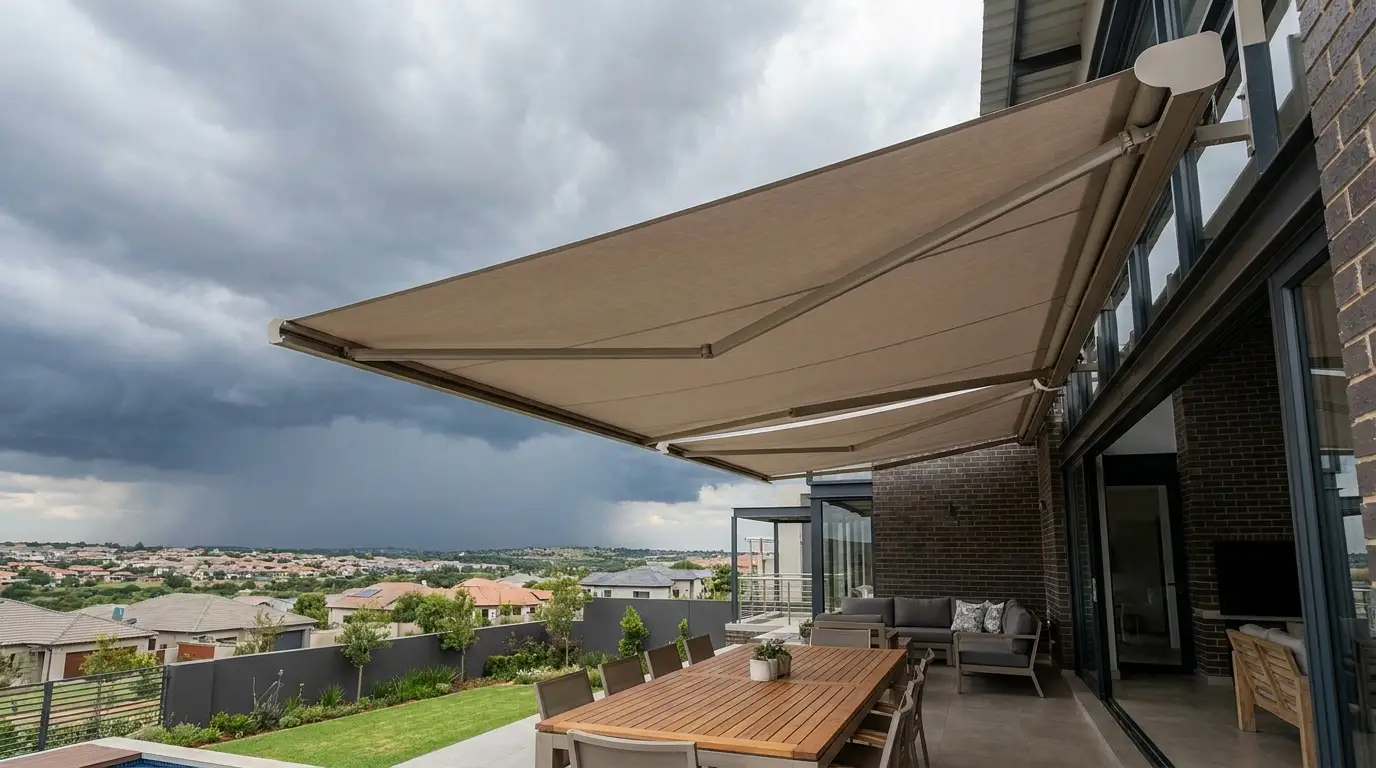
A folding-arm awning must retract, and must be able to retract quickly. It is shade equipment, not roofing. Motorised with a wind sensor, it pulls itself in as the gust front arrives instead of after; that sensor is standard advice from us here, and it costs a fraction of a replacement.
Hail is the honest limit. No awning fabric on the market is a hail product. If a storm carries stones, an extended awning is damaged, and anyone who tells you otherwise is selling. The answer is a system that is already closed, which is exactly what an automatic retract buys you.
A closed roller shutter puts a physical layer over the glass, which is genuinely useful when a storm is throwing debris around the garden. We will not overclaim it — aluminium slats can dent — but a shutter that is down is doing more for that window than a blind on the inside ever can.
Arms still out with the front already visible over the estate — the moment a wind sensor exists for. Ten minutes later this awning should be back in its cassette.Six
The other half of the highveld year
From about May the storms stop and the sky empties. Highveld winters are dry, bright and cold at night, with frost a normal event on the plateau.2 A clear night sky is the most efficient heat sink there is, and the coldest surface in your house at four in the morning is almost always the inside face of a window.
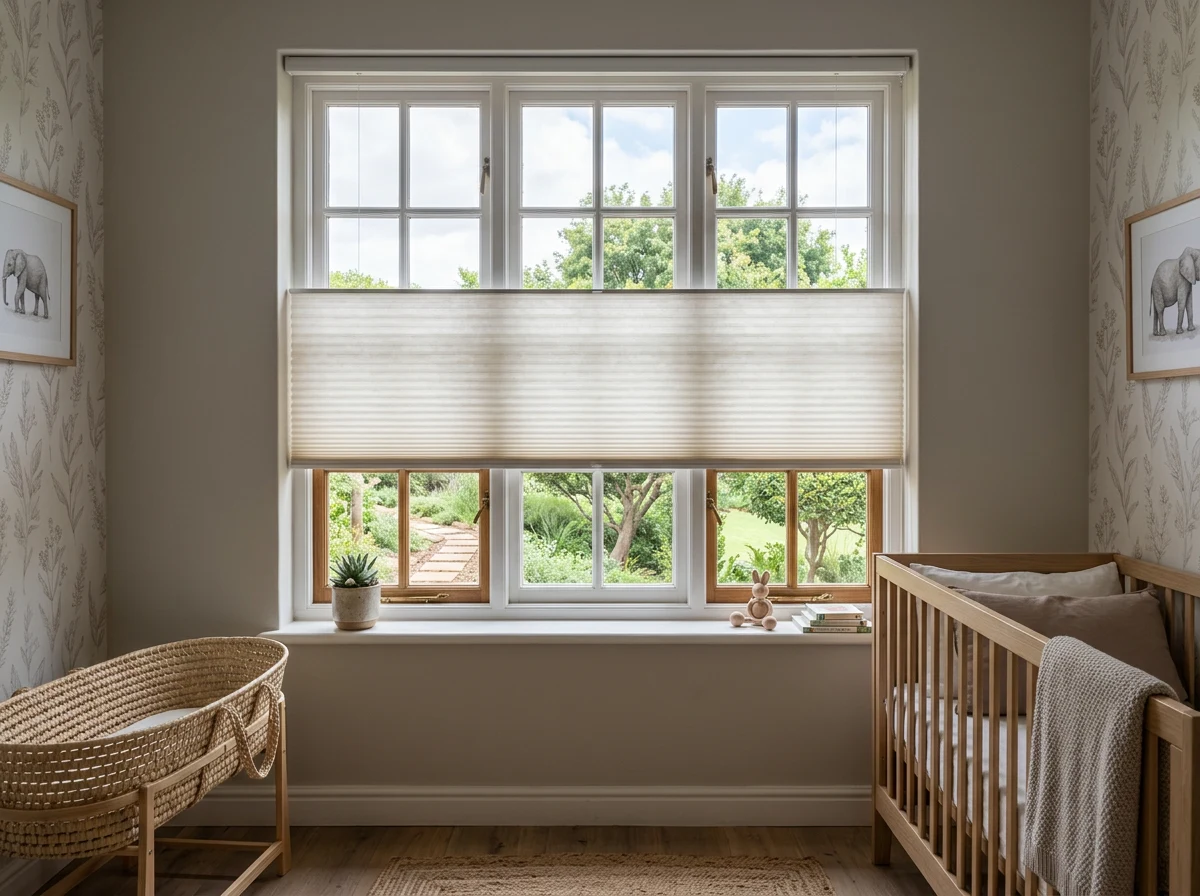
This is where an insulating blind stops being a nicety. A cellular honeycomb fabric is built as rows of cells that hold a layer of still air between the fabric and the pane. Still air is the insulator; the fabric merely keeps it in place. Closed at dusk it slows the loss of the day's warmth through the glass, and it works the same way in reverse against a hot afternoon.
A winter routine that costs nothing
Close the blinds on every elevation at dusk, before the room has started to cool. You are trapping warmth you already have rather than trying to recover it at ten o'clock.
Open the north-facing ones by mid-morning. That low 40-degree winter sun is the cheapest heating in the house and it costs you nothing but a habit.
Order cellular blinds top-down and bottom-up where a room wants privacy at street level but light at the top — one blind, two positions, and the sky stays in the room.
Held mid-window rather than fully down: the cell fabric covers the cot's eye line while the garden and the top light stay open.Seven
Glass you cannot reach
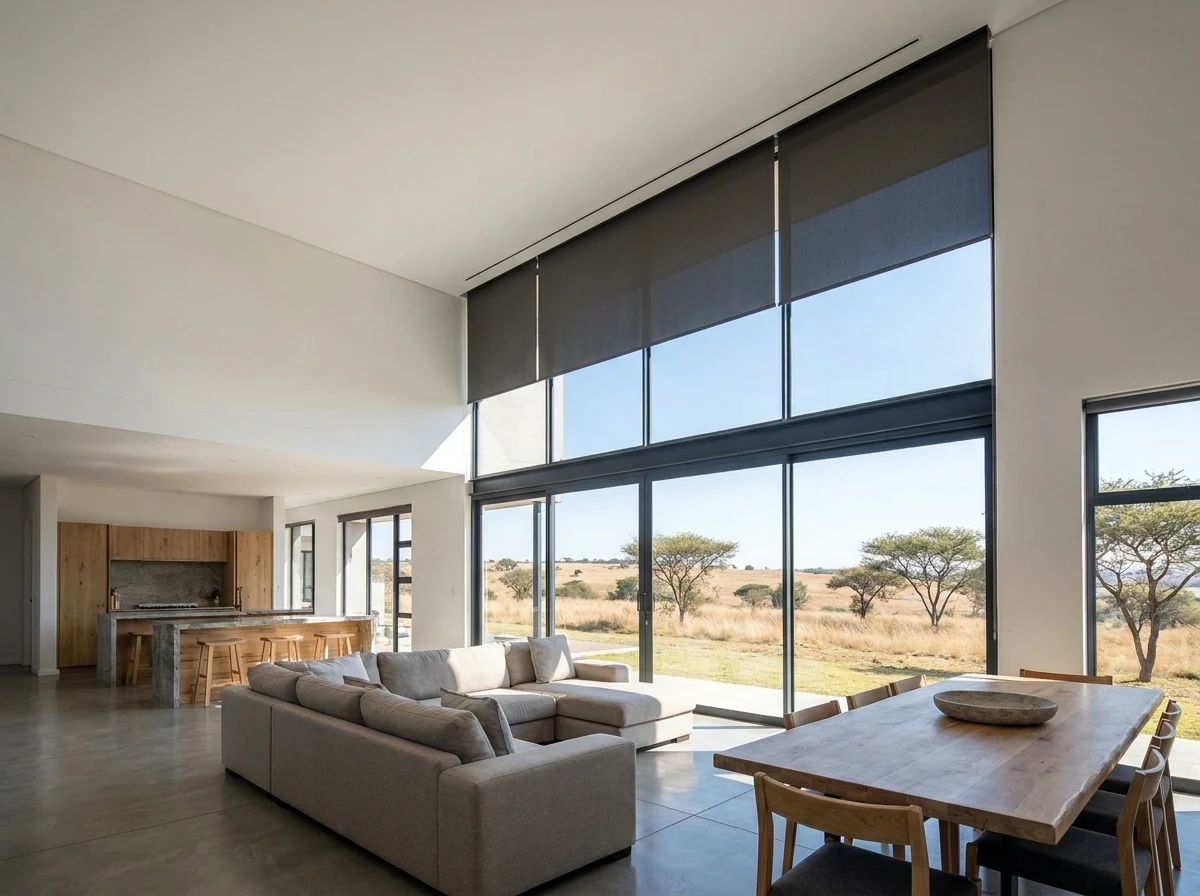
Estate houses of this generation are full of double-volume living rooms, stairwell windows and clerestory bands above a slab line. They are the best thing about the architecture and the worst thing about window covering, for a completely practical reason: nobody is putting a ladder up in a stairwell twice a day.
An unreachable window that has no covering is not a design choice; it is the window doing whatever it likes to your room. Two ways to fix it honestly:
Motorise it. A battery tube is the simpler retrofit and needs recharging occasionally — so the question at the measure is whether that tube can be reached at all when the time comes. A wired motor is the better long-term answer where a supply can be got to the head of the opening.
Recess it. Where a ceiling detail allows, the blind can be built into a slot at the head of the opening so only fabric shows. It looks like nothing is there, which on a wall of glass with a view behind it is usually the point.
Fabric out of a ceiling slot on the high band, glass left clear below — the top half of a double-volume wall is where the heat gets in.Eight
Before anything gets fixed to the outside
Anything mounted on the outside of a Southdowns house changes what the street sees, and in an estate that is governed. Interior blinds are a furnishing decision and involve nobody but you. External venetians, roller shutters, zip screens and awnings are an alteration to the elevation, and the estate's architectural guidelines have a view on those.
We will not paraphrase your guideline document here, because getting it wrong is expensive and the rules are the estate's to state, not ours. Ask the HOA office for the current version, send it to us, and we will tell you plainly what fits inside it and what does not. From our side we keep profiles slim, colours quiet and paperwork complete — drawings and product data supplied so a submission is straightforward. What we will never say is that approval is a formality.
Nine
The part we cannot do from a desk
Everything above comes off published data and a compass. These five come off your house, and they are the reason the measure is free and unhurried:
Which way each room genuinely faces. Estate roads curve, and identical houses sit on different rotations. Two neighbours with the same plan can need opposite specifications, and a compass on site settles it in a minute.
How deep the overhang really is. The whole north-wall argument in this guide depends on your particular eave. Measured, not assumed.
Reach and power. Which openings need a motor, whether a battery tube can be recovered for charging, and whether a supply can get to the head of a double-volume window.
What the wall is behind the plaster. Brick, block, a stone-clad face or a lightweight upper build all take a different fixing — and one of them may rule out an external product on that elevation entirely.
What the estate guideline permits for your street and your house type, read rather than guessed.
All five are far cheaper to establish before a quote than after a fitting.
Next step
Start with the west wall
Tell us which room is unusable and roughly when you would like it sorted. One of our expert consultants will contact you shortly to arrange your free in-home measure, samples in hand, and a written per-window quote afterwards.
→
We walk it with a compass
Every opening is specified on its own orientation and reach, not on the elevation next door.
→
Nothing quoted sight-unseen
No price leaves us before someone has measured the opening, and we will not guess one down the phone.
Sources
Where the numbers came from
Every figure quoted above traces to one of these. The altitude-to-UV arithmetic is described as our own working from the published rate, and every product recommendation on this page is our opinion, given free and without obligation.
Wikipedia — Centurion, South Africa (the town's elevation of roughly 1,453 m above sea level, and its position in Gauteng between Pretoria and Johannesburg).
Wikipedia — Highveld (the interior plateau carrying Gauteng, the eastern Free State and Mpumalanga; a summer-rainfall climate delivered largely by afternoon and evening thunderstorms, with dry, clear, frost-prone winters).
Gaisma — Pretoria sun path data (December-solstice noon altitude about 87° with a sunset bearing near 243°; June-solstice noon altitude about 40° with a sunset bearing near 295° — the nearest published station to Centurion).
World Health Organization guidance on solar ultraviolet radiation, as reported in Solar and Ultraviolet Radiation (UV intensity increases by roughly 10–12% per 1,000 m of altitude, because there is less atmosphere, aerosol and ozone overhead).
South Africa Online — Hail in South Africa (hail occurs more frequently over the highveld areas of Gauteng, the eastern Free State and Mpumalanga than elsewhere in the country), with the seasonal peak described in Severe weather over the Highveld of South Africa during November 2016 (October and November carry a high frequency of severe storms over the highveld).
Nothing on this page is an estate-approval opinion, an insurance assessment or a structural report. Your homeowners' association, your insurer and a suitably qualified professional are the authorities on those.